


The Microsoft Teams Vulnerability Every Business Leader Needs to Know About

Your employees are using Microsoft Teams right now — on their phones, on the go, between meetings, from home. It is one of the most trusted communication tools in the modern enterprise. But as of June 9, 2026, there is a confirmed security vulnerability in the Android version of Teams that every business leader should have on their radar.
This is not a story about obscure software that only affects a handful of organizations. This is about one of the most widely deployed workplace tools in the world, and a flaw that — if left unpatched — could hand an attacker the keys to your business.
What Has Happened
Microsoft has officially disclosed a security vulnerability in Microsoft Teams for Android, tracked as CVE-2026-42835. The flaw has been rated Important in severity, carrying a CVSS score of 8.1 out of 10 — a level that security professionals treat with urgency.
The vulnerability was discovered by researcher Ofek Levin of Enclave and responsibly reported to Microsoft through its coordinated disclosure program. A patch has been released via the Google Play Store. No active exploitation has been observed in the wild — yet.
That last word matters.
Why This Is Not Just an IT Problem
Executives often assume that vulnerabilities are IT’s domain — a technical inconvenience that the security team will quietly resolve. CVE-2026-42835 deserves a different level of attention, for three reasons.
First, the attack requires almost no effort. The CVSS metrics tell a clear story: the attack vector is the network (remotely exploitable), the complexity is low (no specialist knowledge required), and any authenticated user account is sufficient. An attacker does not need physical access. They do not need the target to click on anything.
Second, what is exposed is genuinely sensitive. Microsoft confirmed that a successful exploit allows an attacker to read portions of the device’s heap memory — where authentication tokens, session data, cached credentials, and the content of ongoing conversations are stored. Stolen tokens bypass multi-factor authentication. They open a door that most organizations believe is firmly closed.
Third, the impact scores are unambiguous. The vulnerability carries a High rating for both confidentiality and availability impact. In the wrong hands, it is a foothold into your enterprise environment.
The Broader Risk: Unmanaged Devices
Many organizations have embraced bring-your-own-device (BYOD) policies, or have employees accessing Teams on personal Android phones that are not under centralized IT management. A patch being available on Google Play is only useful if devices are actually updated.
In organizations where mobile device management (MDM) is inconsistent or absent, there may be dozens — or hundreds — of devices running vulnerable versions of Teams right now, with no visibility and no control. This is not a hypothetical. It is the operational reality of most mid-sized businesses.
What the Timeline Looks Like
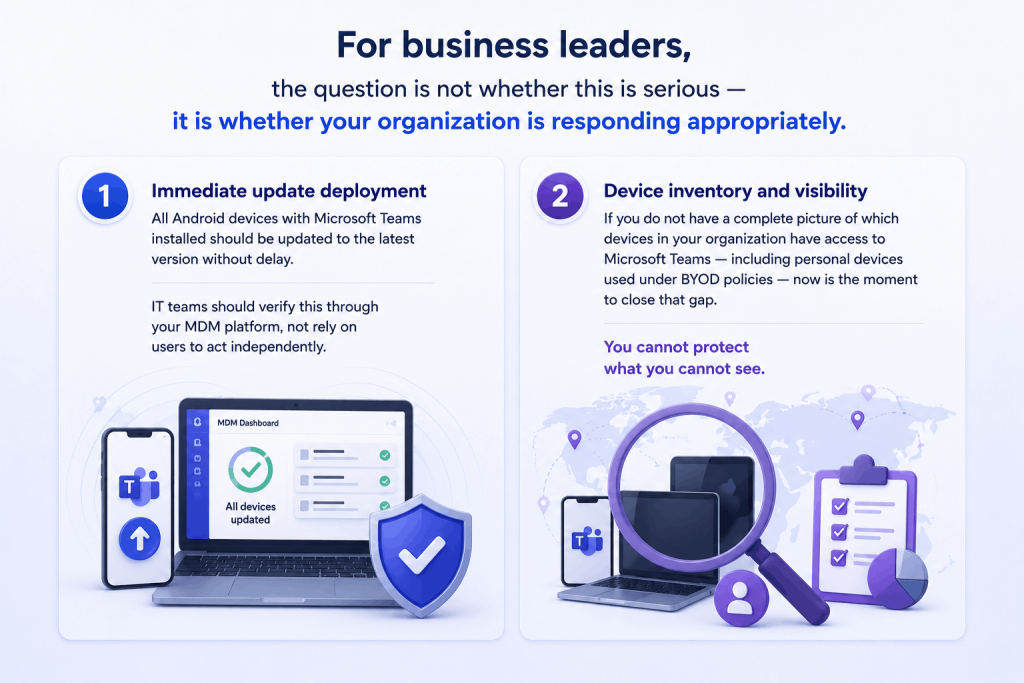
Understanding the risk requires understanding how vulnerability exploitation typically evolves:
- Days 1–7: Security researchers and threat actors analyse the advisory. Exploit code begins to be developed privately.
- Days 7–30: Proof-of-concept code often appears publicly. The window for easy exploitation opens.
- Days 30+: Automated scanning tools incorporate the vulnerability. Opportunistic attackers begin targeting unpatched systems at scale.
CVE-2026-42835 was disclosed on June 9, 2026. The clock is running. The organizations that act now are the ones that never appear in the breach report.
What Good Looks Like: The Response Checklist
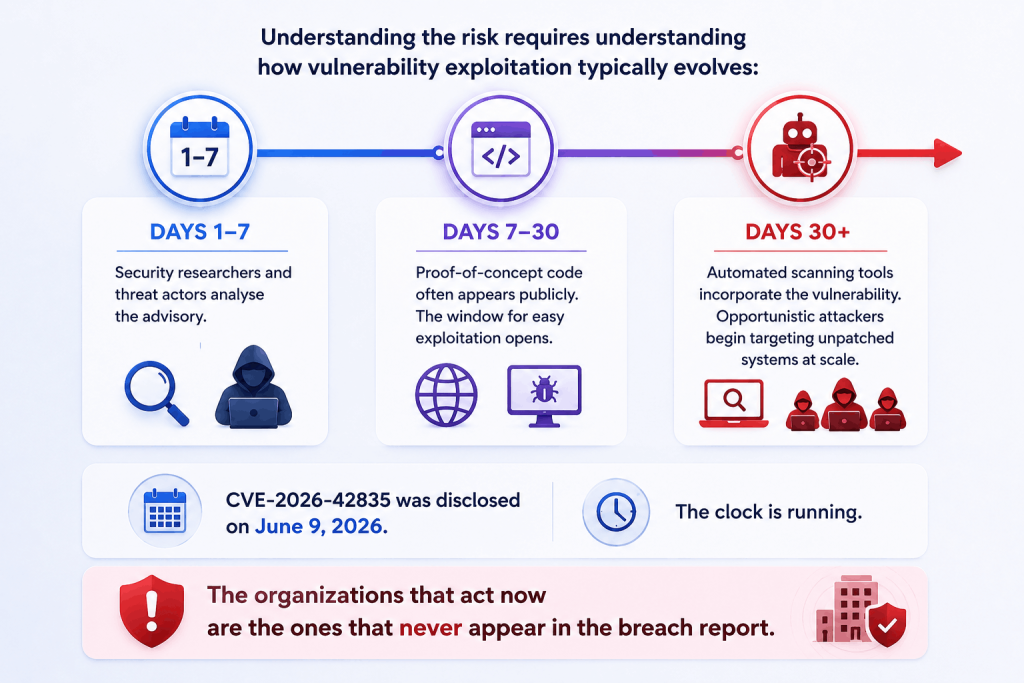
For business leaders, the question is not whether this is serious — it is whether your organization is responding appropriately.
1. Immediate update deployment — All Android devices with Microsoft Teams installed should be updated to the latest version without delay. IT teams should verify this through your MDM platform, not rely on users to act independently.
2. Device inventory and visibility — If you do not have a complete picture of which devices in your organization have access to Microsoft Teams — including personal devices used under BYOD policies — now is the moment to close that gap. You cannot protect what you cannot see.
3. Token and session review — For organizations with elevated risk profiles (finance, legal, healthcare, government-adjacent), consider proactively revoking active Microsoft 365 session tokens for mobile users. This forces re-authentication and eliminates any tokens that may have been silently compromised.
4. Staff awareness — Employees need to understand that keeping work applications updated is a security responsibility. A brief internal communication goes a long way.
5. Review your mobile security posture — If this vulnerability has revealed gaps in how your organization manages mobile devices and application updates, use it as a catalyst. BYOD policies, MDM coverage, and mobile application management (MAM) require regular review.
The Bigger Picture
CVE-2026-42835 is a single vulnerability in a single application. But it is also a mirror. It reflects the reality that enterprise attack surfaces have shifted dramatically — away from the hardened perimeter of the corporate office and onto the personal devices, remote connections, and consumer applications that now define how work gets done.
Cybersecurity is no longer purely a technology function. It is a business continuity function. The decisions made in the boardroom — about device policy, security investment, and risk tolerance — determine how exposed an organization is when the next CVE drops.
And there will always be a next one.
How Alliance Pro Can Help
At Alliance Pro, we work with business leaders to cut through the noise and focus on what actually matters — identifying vulnerabilities before they become incidents, building security postures that scale, and ensuring that when advisories like CVE-2026-42835 are published, your team is already a step ahead.
Get in touch with the Alliance Pro team today — because in cybersecurity, the best time to act is always before something goes wrong.








Leave a Reply