



CypherLoc: The Browser-Locking Scareware That Has Already Hit 2.8 Million Times in 2026

Your endpoint detection didn’t fire. Your EDR stayed silent. Your users saw a full-screen Microsoft warning, panicked, and called a fake support number — and by the time you found out, the damage was done.
Why Your Security Stack May Not See It Coming
This is where CypherLoc separates itself from your average phishing lure, and why security teams need to pay close attention.
The payload is encrypted and condition-gated. The malicious code embedded in the web page will not execute unless very specific conditions are met — a required URL fragment hash must be present, and the page must pass a series of cryptographic integrity checks at runtime. If a scanner, sandbox, or automated analysis tool opens the page without those conditions, the payload refuses to activate and the page simply redirects to a blank screen. The attack never reveals itself.
This is a direct, deliberate assault on your detection infrastructure. Traditional URL scanning, sandboxed detonation, and static analysis are all effectively blinded.
It lives entirely in the browser. No binary is dropped. No process is spawned. No registry key is touched. CypherLoc executes inside the browser, making it largely invisible to endpoint protection tools that look for file-system or process-level indicators.
It fights back against inspection. If a user or analyst tries to examine the page while it’s running — opening DevTools, right-clicking, or attempting to navigate away — the page deliberately causes the browser to slow, glitch, and destabilise. For the victim, this confirms the illusion that their machine is critically compromised.
The Attack Chain, Step by Step
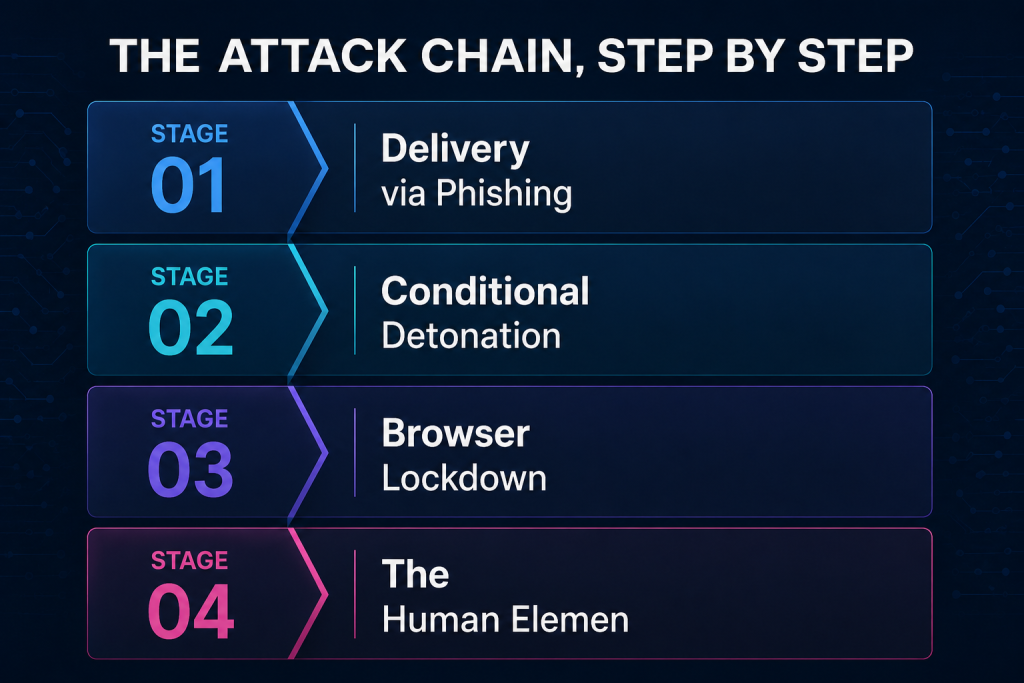
Stage 1: Delivery via Phishing
The attack begins with a phishing email. The link may be embedded directly in the body or hidden inside an attachment. The initial destination page appears completely benign.
Stage 2: Conditional Detonation
The page silently evaluates its environment. If real-user conditions are satisfied, the encrypted payload decrypts and executes. The page transforms.
Stage 3: Browser Lockdown
This is where the psychological operation begins in earnest:
- The browser enters full-screen mode instantly
- Context menus are disabled; the cursor is hidden
- The screen is flooded with overlapping warning overlays
- Warning sounds play on every click
- Every attempt to close the window or tab triggers a “relock” — the browser snaps back into the locked state.
- The user’s real IP address is retrieved and displayed prominently, creating the impression of active surveillance.
- A fake login popup appears — and predictably fails — escalating the sense of crisis.
Stage 4: The Human Element
A fraudulent Microsoft support phone number is displayed throughout. It is presented as the only way out.
When victims call, they are not met with a bot. Human operators — posing as Microsoft support staff — take over the scam through live conversation. What happens next depends on the operator: remote access, credential harvesting, and financial fraud are all on the table.
The Uncomfortable Truth About Modern Scareware
CypherLoc doesn’t need to compromise your infrastructure. It compromises your people.
Saravanan Mohankumar, Manager of the Threat Analysis Team at Barracuda, put it plainly: “It uses the browser itself to pressure victims into acting. By combining hidden code, delayed activation and aggressive on-screen behaviour, it creates a convincing illusion of a serious system problem while leaving very little technical trace.”
This is the direction the threat landscape is moving. Attack groups are rationally optimising — if endpoint detection has matured, move the attack to the browser. If malware sandboxes are catching payloads, gate the payload so sandboxes never see it. If technical exploits are too visible, trigger human psychology instead.
CypherLoc is not a blunt instrument. It is a carefully engineered pressure campaign.
Key Takeaway: The Attack Surface Is Changing
CypherLoc highlights an important reality for modern organisations: attackers are increasingly shifting away from traditional malware-driven endpoint compromise and moving toward identity, browser, and human-layer exploitation.
Security teams have spent years strengthening endpoint detection and hardening infrastructure. In response, threat actors are adapting. Rather than dropping malware that can be detected by EDR or antivirus tools, modern attacks increasingly exploit trusted channels, web browsers, user psychology, and identity systems to achieve their objectives with minimal technical footprint.
For organisations, this means cybersecurity strategies must evolve beyond endpoint-only thinking.
The modern attack surface is rapidly expanding towards:
Identity as the New Perimeter.
Compromised credentials, session hijacking, MFA fatigue, and fake authentication prompts are increasingly replacing malware as the attacker’s preferred entry point. Strengthening identity security through MFA, conditional access, privileged access management, and continuous monitoring is no longer optional.
Browser and Web-Based Threats
The browser has become one of the most targeted enterprise attack vectors. Browser-native attacks, malicious redirects, phishing sites, fake login portals, and scareware campaigns like CypherLoc often leave limited endpoint-level indicators. Organisations should evaluate browser isolation, DNS filtering, secure web gateways, and web traffic inspection as part of a layered defence strategy.
User Awareness as a Security Control
Even the most advanced technology stack can fail if attackers successfully manipulate human behaviour. Security awareness must evolve from annual compliance training into practical, scenario-based education that prepares users to recognise phishing, fake technical support scams, malicious browser behaviour, and identity-based attacks.
Layered Visibility Across the Security Stack
No single security control can stop threats like CypherLoc in isolation. Effective defence requires coordinated visibility across email security, endpoint detection, identity monitoring, browser protection, DNS filtering, and SOC-driven incident response.
The bottom line
Modern cyberattacks increasingly target trust, behavior, and identity rather than systems alone. Organizations that continue to focus only on endpoint security risk leaving critical visibility gaps in the areas attackers are now actively exploiting.








Leave a Reply